Abundance
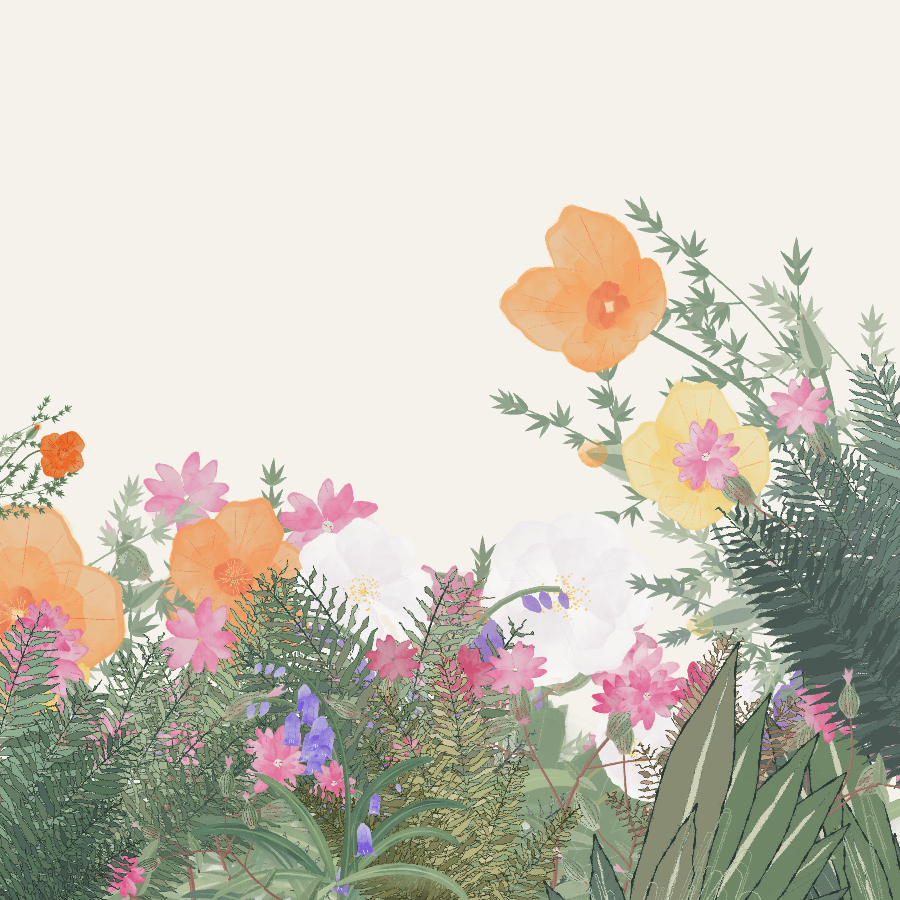
Abundance is a generative garden. Six plants, a few rules about where they may sit, and a seed. The square below is one thicket, drawing itself on the paper while you read.
I wanted a garden that would keep arriving. A single picture, chosen from a pile of renders and framed, would have stopped too soon. I wanted a way of growing them that I could leave open.
The Douanier
The idea started with Henri Rousseau, called Le Douanier because he worked the Paris tolls. He painted jungles he had never seen. He never left France. The plants came from the glasshouses at the Jardin des Plantes, and from picture books. Writing to the critic Arsène Alexandre, he said, "When I go into the glass houses and I see the strange plants of exotic lands, it seems to me that I enter into a dream." The pictures he made from that are a wall of leaves, stacked until only a slit of sky remains.
That wall is what I wanted. Ferns doing the mass. A few loud heads punching through. The first versions of Abundance tried to put that understorey on a page: flat colour, a dark edge, poster-like, a hedge of outlined shapes. The grammar was right. The paint was wrong. Rousseau's oil sits dry and even. What I ended up needing was a wetter mark, and a garden that could keep arriving rather than one jungle, finished.
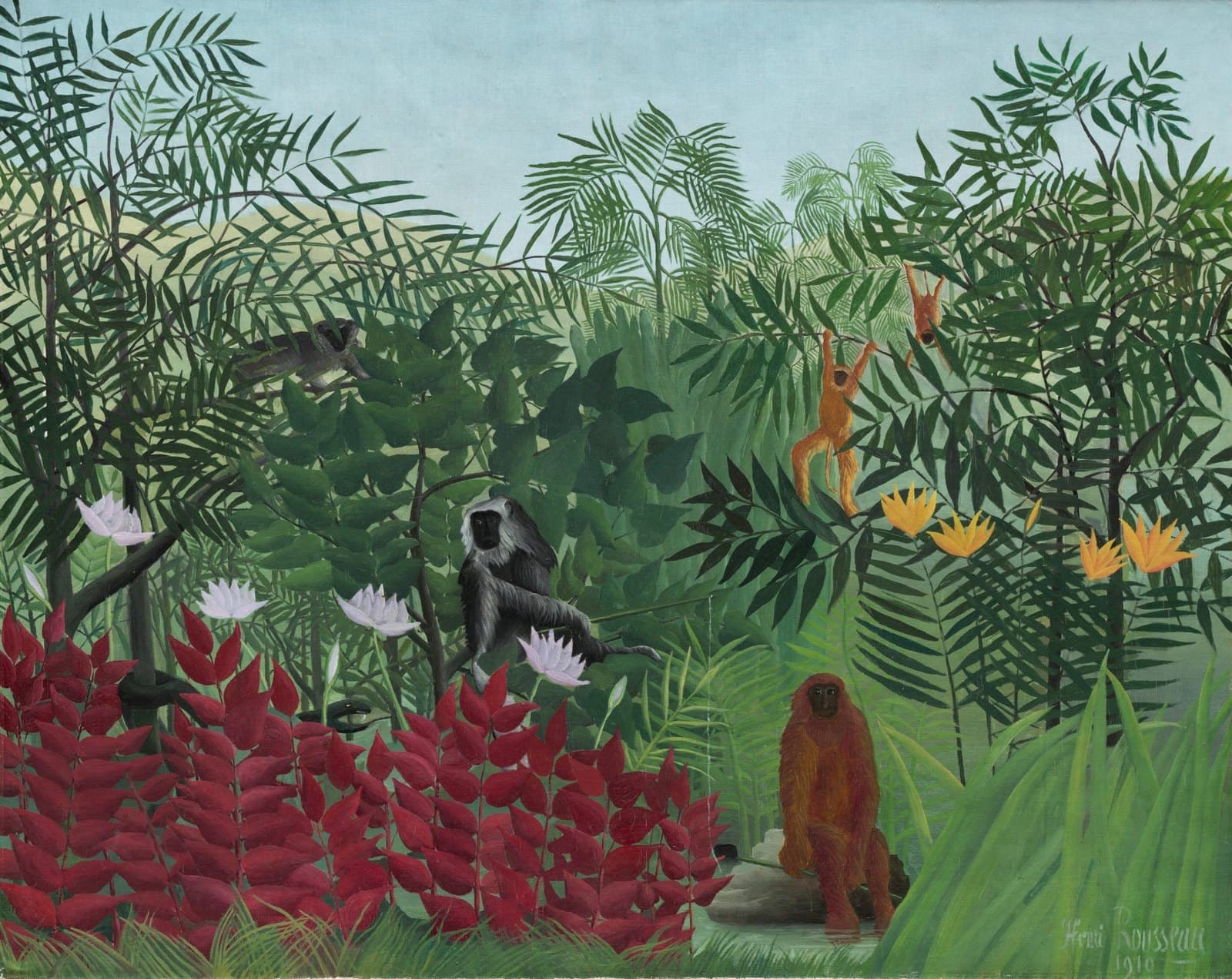
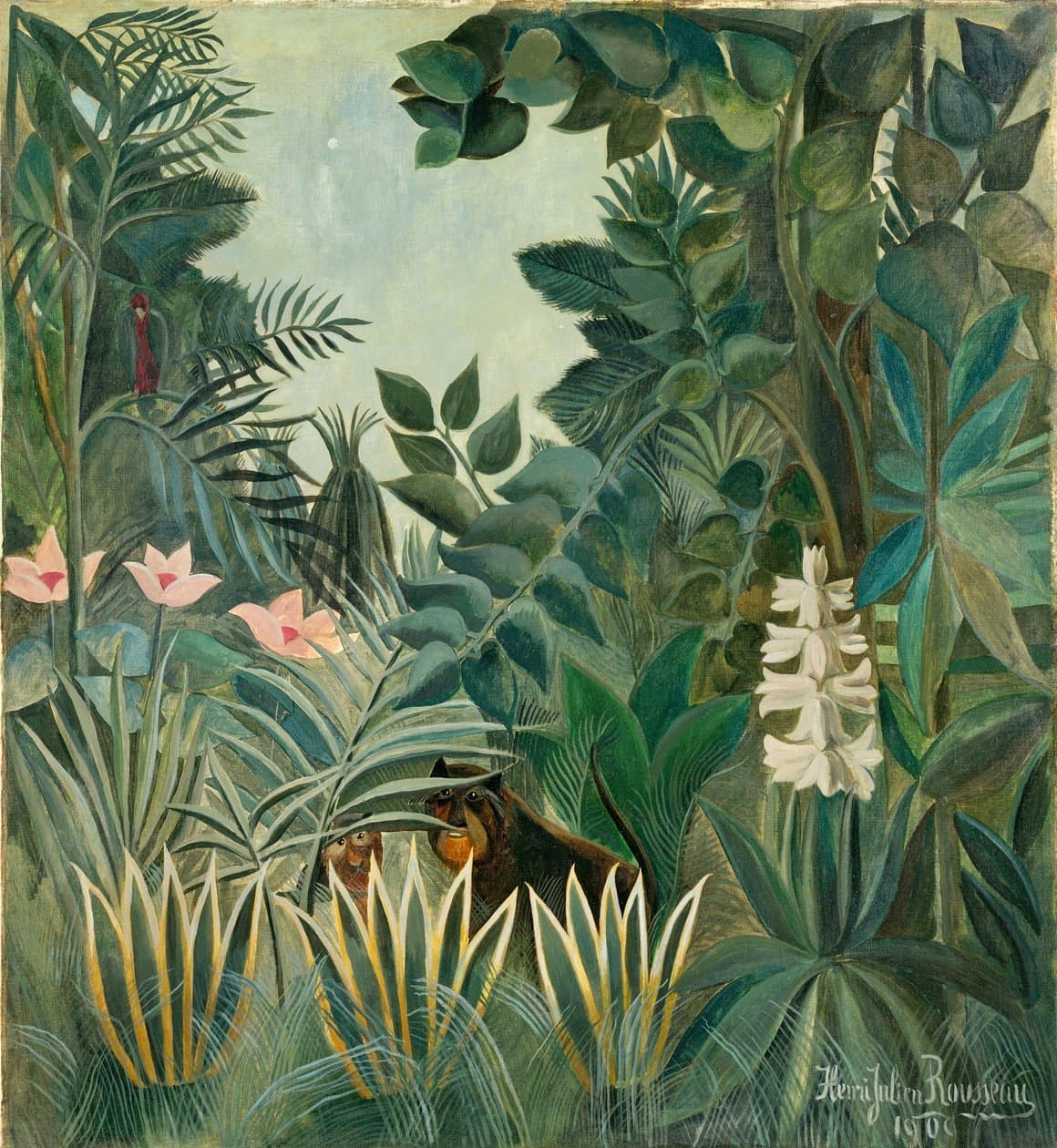
In Tropical Forest with Monkeys, painted in the last months of his life, five primates sit in a thicket assembled from the Paris glasshouses. Rousseau took specimens from the Jardin des Plantes and enlarged them. The yellow-orange lotuses ought to float. He stood them in the air instead. The Equatorial Jungle, from the year before, does it with less sky: a white hyacinth, pink saucers, sword leaves along the floor, two faces looking out as if you had walked in on them. I kept the plants and left the animals. Abundance is a garden. There is no monkey looking out.
The plants
There are six families in the vocabulary: poppies, bluebells, anemones, campions, ferns, and bushes. Each family is a small drawing program. Give it a seed and it grows one specimen: how the stem leans, how open the bloom is, how far a frond unfurls. The same family can come out tall or slumped, pale or deep. I looked at a lot of plants that were almost right and threw them away. The ones that stayed are ordinary TypeScript. They do not call a model. They just draw.
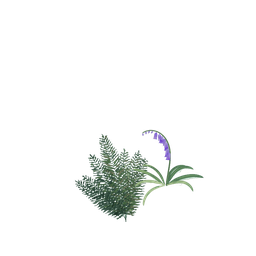
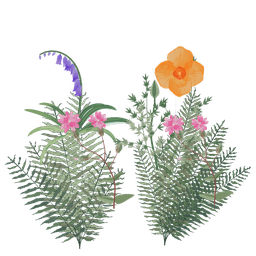
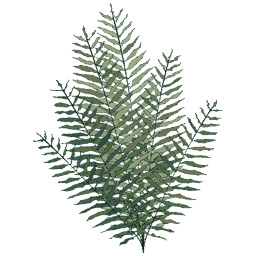
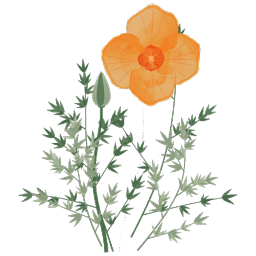
Poppies carry the largest heads, often pale yellow or orange, sometimes with a bud still shut beside an open bloom. A bluebell hangs its bells from a curved stalk. The anemone is the pale saucer with a yellow centre, over dark lobed leaves. The campions fork, pink, with a swollen calyx under the flower. Ferns and bushes do the mass the flowers sit in.
Those specimens only become a garden once they are stacked. Large foliage sits at the back and fades a little into the paper. Blooms lead at the front. Everything is rooted along the bottom edge, often cropped so the floor reads as undergrowth rather than a row of pots. I keep the top of the frame empty. If the thicket climbed the whole square it would feel like a hedge pressed against glass.
Seeds
A seed is a small number you feed into a random number generator before anything is drawn. The generator is not random in the everyday sense. Give it the same seed and the same slider settings, and it produces the same sequence of numbers, and so the same garden. Change the seed and you get another thicket. The page you are looking at begins at 126354.
That is why the gardens can keep coming without me sitting over them. When a thicket finishes, the page holds it for a moment, washes it back into the paper, then adds one to the seed, walks the sliders, and grows another. The first garden is the one I tuned. After that the foliage, the density, and the mix among the flowers move on their own. There is no last image. The tab can stay open. If you have asked the computer not to animate, it grows one garden and stays there.
Guiding a garden
The sliders retune the garden on the paper. Move one and the square wipes and grows again from the same seed family, with the new lean. The first long one walks the number of plants. It opens a little sparse. In the middle it keeps the count I tuned. Drag it left and the thicket thins to a few stalks. Drag it right and it packs until the cream almost goes. The second trades foliage for flowers. It opens a little toward the blooms. Ferns and bushes fill the back first; only the overflow reaches the front, so the flowers are not buried. In the middle it keeps the split I tuned. Drag it left and the thicket is almost all ferns and bushes. Drag it right and the foliage gives way until the band is flowers. When the page walks on its own, the sliders move with it — a sparse roll shows as sparse.
The four sliders under that retune the mix among poppies, bluebells, anemones, and campions. They share one pot: turn one down and the others take its share. They do not choose a picture. Even with the same settings, the seed still decides most of what you see: which specimen arrives, how it leans, where it lands. The sliders point the program and leave the placing to the seed. I like the gardens I would not have composed.
The average garden
Because the work keeps looping, you see more than a shortlist. I could have grown a hundred images, kept ten, and never shown the rest. Here the next garden loads whether it is a good one or a thin one. That changes what the program has to do. The average output has to hold. The weak ones have to be rare enough that watching for a while does not feel like waiting for a fluke.
I would grow a set, look for the gardens that had gone wrong, and change the plants or the placement until those cases were less likely. A poppy that covered its own bloom. A floor with a hole of cream along the bottom edge. Most of the work of Abundance was that: sitting with the output I did not want, and making it happen less often.
The gardens still surprise me. A system that only repeated the one good composition would not be worth leaving open. Too little variety and you get bored. Too much and it stops feeling like one work.
When a garden is working I notice the paper first: a band of cream at the top, then ferns as a dark mass, then a few heads that have made it to the front. When it is not, the square is either a green wall or a few stalks on empty ground. The density slider walks between those two.
Compute, once
I used AI while writing the plant code: to draft a species, to try a variant, to throw work away. That compute was finite. Once a species is accepted it is TypeScript, the same as anything else I would keep. This page does not call a model. The garden you are watching is what that spell of compute left behind, code that can keep flowering without spending it again.
The page is cheap to leave running. You can move the sliders, wait for the next seed, and the same six families recombine. The cost is already spent.
Earlier states
The first versions were flatter and more graphic, a hedge of outlined shapes on white, closer to those Rousseau plates than to a garden on paper. The mark was still dry. Later I packed ferns until the paper almost disappeared. Those were closer to the Douanier's wall of leaves, but the flowers had nowhere to sit, and the top of the frame was gone.
The current mix keeps a cream sky. The flowers sit against a real mass of foliage, and you can still see the paper. I think that empty band is doing as much work as the plants.
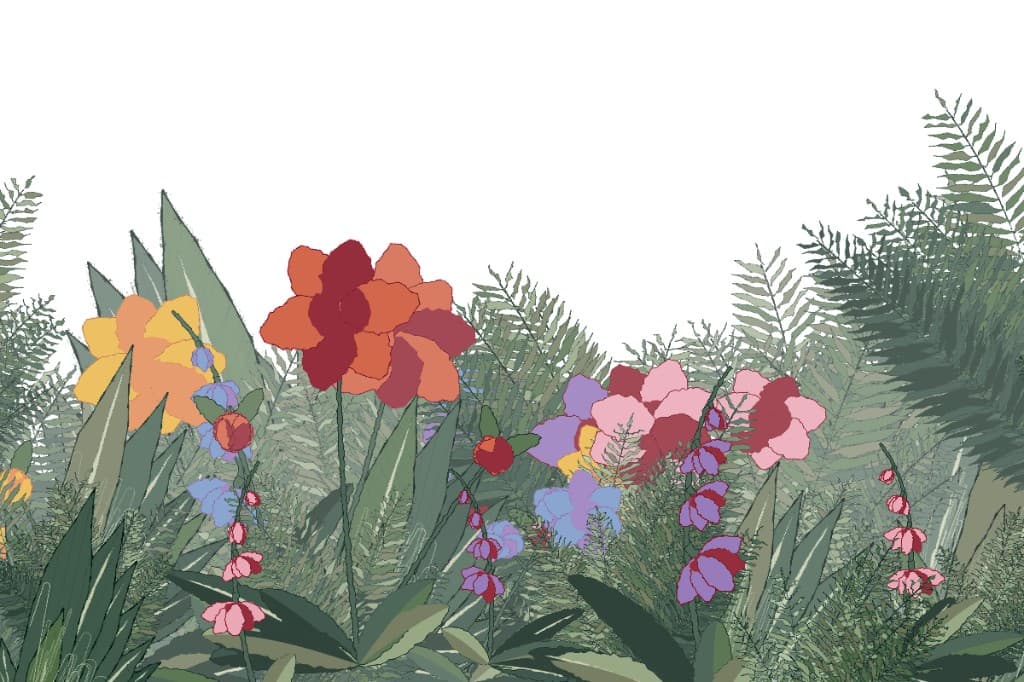
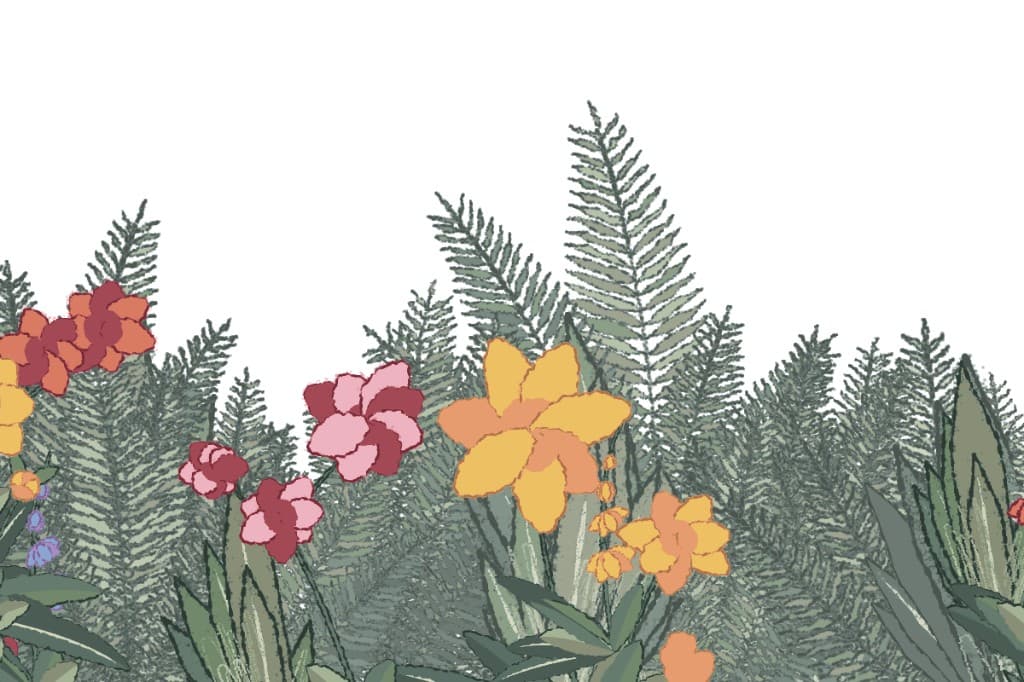
I still watch it. Some gardens I would hang, and some I would skip. Both kinds come from the same program. Abundance is the subject and also the method. One set of instructions, as many gardens as you have time to watch.